
When Content Is Abundant, Physical Presence Is Scarce
When content becomes endless, presence becomes fragile. This Dialogue piece reflects on why Bayview Hub and Mendpress are trying to protect slower forms of attention, conversation, and bodily co-presence in a culture increasingly shaped by speed, simulation, and digital excess.
Share this article
Share notes
A clean title, summary, and link for posting by hand to LinkedIn, RedNote, WeChat, and similar platforms.
Listen
Podcast Episode
20:53
When content is abundant, presence becomes scarce.
That is not because human beings have stopped wanting depth, conversation, or real encounter. It is because more and more of life is now structured around speed, circulation, and mediated response. We are surrounded by language, but not always by consequence. We are surrounded by connection, but not always by company.
This piece reflects on that condition and on the question that follows from it: what must be protected if we do not want human presence to become thin, performative, or replaceable?
Bayview Hub matters here not as a content brand, but as an attempt to hold open a different kind of field — one shaped by art, music, gathering, weather, landscape, slowness, and the friction of real encounter. Mendpress matters because such experiences should not vanish into passing updates. They need language, record, and reflection.
What is at stake is not nostalgia for a pre-digital world. It is whether we can still make room for forms of life in which attention deepens, conversation becomes real, and presence is felt as something more than proximity.
Show notes
Companion text
# When Content is Abundant, Physical Presence is Scarce
In this audio essay, we explore the contrast between digital abundance and the scarcity of meaningful human interaction.
- Discover how Bayview Hub seeks to cure the malaise of screen saturation.
- Learn about the four structural pillars that anchor Bayview Hub's mission.
- Understand the role of MenPress in preserving experiences and fostering dialogue.
- Engage with the idea that our flaws in communication signify our humanity.
Speakers
None
Transcript
Full transcript
Imagine you're listening to a deep dive, like this one, and the host pauses. They take a breath, they stumble on a word, maybe they mutter something under their breath, and then they correct themselves to find the right phrasing. Like we literally do all the time. Exactly. But what if I told you that in, say, five years, that tiny, awkward mistake might be the absolute only proof you have that the person speaking to you is actually human? That is a terrifying thought, honestly. Right. But we are entering this era where perfection is just, it's incredibly cheap. And our flaws, our hesitations, they're becoming our only remaining fingerprints. Yeah. It's a radical shift in how we understand authenticity. Like as artificial intelligence makes flawless communication ubiquitous, the messy, slow, kind of unpolished reality of human interaction suddenly becomes the most valuable resource we have. Okay. Let's unpack this. So our mission is to explore the changing value of physical spaces and, you know, real-world experiences in this age of AI. Yeah. We're looking at something very concrete today. We are. We're pulling from a foundational, honestly, incredibly detailed document outlining a cultural initiative. It's built by a founder named Leon. Right. And it's an ambitious project. Huge. The project has two massive halves. First, there's a physical ecosystem in Victoria, Australia called Bayview Hub. And second, it has this editorial publishing arm called MenPress. And the entire ambition of this project, the whole point, is to figure out how to cure the specific cultural sickness of our screen-saturated lives. And to understand that cure, we really have to look closely at the diagnosis Leon presents in the source material. Right. What is the actual disease here? Well, his central thesis points out a simple economic reality. AI is making content endlessly abundant and frictionless. Oh, totally. You can generate a million words in a second. Exactly. But when something becomes hyper-abundant, basic economics dictates that something else becomes scarce. Okay. So what is the scarce thing? Because it isn't information. I mean, we're drowning in information. We really are. The text argues that the true scarcities of the future are physical presence, shared attention, truthful encounters, and this is key, real public life. You know, I always hear people compare this to an endless digital buffet. Sure. But honestly, that doesn't really capture the, I don't know, the physiological feeling of it. For me, it feels more like a diet of just empty calories or fast fashion, right? It's a good way to put it. It's like we are living in sensory zero gravity. In space, an astronaut's bones will literally decay because there's no physical resistance pushing against them. Wow. Yeah. And I think our brains are experiencing digital zero gravity. We scroll for hours, we consume thousands of images, but because there's zero friction, zero consequence. Our emotional and social muscles are just atrophying. Exactly. The source text describes modern life as emotionally thin and socially flattened. What's fascinating here is the text's concept of synthetic fluency. Synthetic fluency. Okay. What does that mean? It's this idea that polished, perfectly articulated expression is now incredibly easy for machines to imitate. Oh, like chat GPT, writing an email. Right. An AI can write a flawless corporate apology or a perfectly structured marketing pitch in like three seconds. Because that fluency is now synthetic. The things that are genuinely human, slowness, patient attention, spaces that carry actual consequence, they have to be valued much more consciously. So if AI is generating infinite frictionless content, how do we intentionally seek out the hand-knit experiences, the stuff with friction? We have to build spaces for them. Right. So the theory is that friction builds meaning. But I mean, theory is cheap. How do you actually design a space that forces people into that friction without making them just turn around and leave? Which is a real risk. People hate being uncomfortable. Exactly. What is Leon actually building to trap us in a good way in the present moment? And that brings us to the physical layer of the project, Bayview Hub. Located on the Mornington Peninsula. Yeah. To be honest, when I first read about a physical retreat designed to cure digital overload, my immediate assumption was, oh, this is a high-end wellness spa. Oh, totally. Like you hand in your phone at the front desk, they give you a $15 green juice and you do yoga for three days. Right. The digital detox cliche. But the source material is fiercely protective against that exact interpretation. Bayview Hub is not a wellness brand making abstract promises of healing. And it is definitely not a tech startup treating a physical location like, you know, a user acquisition funnel. So what is it? The document described it as a lived field. It's this tapestry of functional physical layers. Like actual businesses. Yeah. There's the Pig and Whistle Tavern functioning as a hospitality base. There's the Shed Theater for live music. Oh, cool. There are vineyards, accommodations like the farmhouse, and these emerging layers including edible gardens, a physical gallery, and non-clinical therapeutic arts. Wait, let's hold on that for a second. Here's where it gets really interesting to me. If it's not a wellness retreat and it's not just a fancy hotel, what is the actual mechanism making it different? I mean, a tavern is just a bar, right? Not in this context. The ambition is to build an ecosystem where someone arrives for a simple transactional reason, like just grabbing a drink at the tavern. Right. But the environment is designed to draw them into a richer public life. The document contains this profound critique of digital platforms here. How so? Well, platforms can scale messages perfectly to millions of people, but they fundamentally fail at producing what the text calls thick shared atmosphere. Thick shared atmosphere, which means what? In practice? Like, what does that actually look like for someone standing inside that tavern holding a beer? It means bodily co-presence. Real places have variables that algorithms just cannot generate. Oh, like unpredictability. Exactly. They have weather that forces you inside. They have the physical acoustics of sound bouncing off wooden walls. They have changing light that signals the passage of time. They have silence. They have awkwardness. Awkwardness. Okay, I love that you brought that up because we spend our entire modern lives trying to engineer awkwardness out of existence. Oh, absolutely. We pull out our phones and elevators specifically to avoid the awkward silence of standing next to a stranger. Tech startups spend billions eliminating microscopic friction points. Make everything one-click. Exactly. But here, Leon's project views friction like an awkward pause, or getting caught in the rain, or having to physically dig in a garden as a vital necessity. Why does friction equal meaning? Because meaning requires consequence, and consequence requires stakes. Oh, you unpacked that. When a digital interaction is frictionless, it requires nothing from you. You can just swipe away. But the friction of an awkward silence, it forces you to acknowledge that the other person in the room is a complex human being, not just a character on your screen. The friction of sudden rain forces you to adapt your plans and interact with your physical environment. The text makes a stark cultural judgment here. It says we are dislocated from the forms of encounter that make life feel real. We're totally dislocated. Okay, so they build this environment where friction and atmosphere force you into the present. What actually happens inside Bayview Hub? How do they structure the days to prevent people from just sitting in the tavern looking at their phones anyway? The ecosystem relies on four structural pillars, and the document really stresses that these are not decorative luxuries or background entertainment. They are forms of repair. Forms of repair. Okay, what's the first pillar? The first pillar is art. Let me guess. Not just having pretty paintings on the wall to serve as a backdrop for Instagram photos. Far from it. The text argues that physical art slows perception. It gives structure to attention. How is that different from looking at art on a screen? Well, when you swipe through a feed, your brain is processing patterns almost instantly, right? Yeah. Searching for the next dopamine hit. Yeah, it's just a blur. But standing in front of a physical artwork demands a completely different cognitive load. Your eyes have to track differently. It forces a state of delayed understanding. You actually have to sit with the confusion of what you're looking at. Exactly. You can't just swipe it away. Okay, that makes sense. What's the second pillar? The second pillar is live music, specifically anchored in the Shed theater. Now I love music, but I have Spotify playing constantly in the background of my life. How does the source material differentiate what happens in the Shed from what happens in my headphones? It really comes down to acoustic physics versus digital compression. Acoustic physics. Yeah. Digital compression creates a shared, time-bound rhythm. The physical vibration in the floorboards, the way the bass hits your sternum. Oh, I love that feeling at a concert. Right. And the fact that a hundred other bodies in the room are absorbing the exact same acoustic energy at the exact same millisecond, that gathers people into one lived moment. Because digital compression turns music into just an isolated background file. Precisely. Live music is an unrepeatable event. You have to be there then, or you miss it entirely. Okay. The third pillar. The third pillar is nature, specifically the edible gardens. Edible gardens. Yeah. And the text mentions this concept of embodied scale here. What does embodied scale actually mean? It means matching human effort to biological limits. You cannot life hack a tomato plant into growing faster. No matter how many apps you use. Right. It requires shared labor over a season. And the neurological shift here is really crucial. Tell me more about that. While scrolling provides an instant dopamine loop, digging in dirt, planting a seed, and waiting months for a harvest, that requires delayed gratification. Yeah. It's a completely different timeline. It literally forces the brain to recalibrate its expectation for reward. It shifts you from instant dopamine to the deeper, slower satisfaction of serotonin. Which brings us to the fourth pillar, gatherings and workshops. Yes. Shared meals and shared tasks. The idea that public trust doesn't start in a comment section. It starts by physically passing a plate of food to someone you don't know or, you know, holding a piece of wood while they saw it. That is the foundation of public memory. Working alongside someone creates an entirely different social bond than debating them online. Okay. I have to push back here though. Sure. Putting myself in the listener's shoes. This all sounds incredibly romantic. It does sound nice. But isn't this just a fancy, privileged, rural retreat? How does digging in a garden or passing a plate of food actually fix the deeply ingrained physiological addiction we have to screens? It feels a little bit like putting a Band-Aid on a broken leg. That's a fair point. And the source material anticipates that exact skepticism. Oh, it does? Yes. It explicitly warns against viewing Bayview Hub as part of the shallow experience economy. You know, where people just pay for a brief, rustic weekend to feel grounded before going back to their stressful city jobs. Right. A temporary escape. Exactly. The deeper claim here is about interruption. Interruption of what? In an age of synthetic, abstract communication, physical labor alongside strangers violently interrupts your digital abstraction. Violently interrupts. Yes. It demands your body. You cannot physically perform the shared task while distracted. This connects to a broader philosophy in the text called MEND. MEND. Let's dig into that. MEND is the underlying emotional platform of the entire initiative. It's concerned with helping modern people move through bad emotions like isolation, anxiety, the thinness of digital life. Moving toward what? Towards self-understanding and reconciliation. The physical pillars we just discussed are merely the vehicles for that repair. Leon is mounting a defense of the last forms of time-bound, embodied human experience that actually carry emotional weight. Okay, so you've built this friction trap. People are coming to Bayview Hub. They're experiencing this thick atmosphere. They're having these serotonin-rich, meaningful moments of repair. Yeah. But human memory is terrible. We forget profound revelations by Tuesday. We really do. So in our fast-paced world, how do you capture this? Because the default modern instinct is to pull out your phone, shoot a quick 15-second video, throw it on social media, and call it a day. Which reduces the profound experience to shallow content. Exactly. And this is exactly why the second half of Leon's project exists, MenPress. MenPress. It is the editorial and publishing layer of the Hub. So MenPress is basically their high-end content marketing engine. Like they have this beautiful physical space. And MenPress runs the blog and the Instagram to drive foot traffic and sell tickets to the Shedd Theater. Actually, that is exactly what Leon vehemently opposes. Really? Yes. And the document is militant about this distinction. MenPress is not marketing. It is not SEO-feller. Okay. The text explicitly rejects empty brand language and AI-generated slop writing. The entire purpose of MenPress is to preserve thought. Preserve thought? It exists to give exact, careful language to lived experience so that the experience isn't lost to the noise. This raises an important question, though. What is the exact relationship between the physical place and the publication? Bayview Hub provides the ground of encounter-letting things happen. MenPress provides the language and record-keeping what happened from vanishing too quickly. I see. It's the difference between a marketing team trying to hype up an event and a meticulous curator in a historical museum. Oh, that's a great analogy. The marketing team just wants the transaction right. They use buzzwords like immersive and unforgettable. But the museum curator wants to preserve the artifact. They catalog it, provide context, and treat the object with dignity so its meaning actually survives. That analogy captures the ethos perfectly. The sources actually outline four specific editorial modes for MenPress to achieve this curation. Okay. What's the first mode? The first is editorial. This is about recovering honest, exact language for an experience. It's about stating a position with seriousness rather than just generating content for clicks. Because if you don't have exact language for an experience, the experience itself becomes blurry. Exactly. What's the second mode? Visual narrative. And this is not about posting flattering, filtered photos of the property. No golden hour selfies. No. The text describes it as documenting the intelligence of ways of looking. What does that mean? It's capturing the traces of physical labor in the garden or the specific way the weather changed the light in the tavern. It's a visual record of reality. Reality not aesthetics. Okay. The third mode is program, right? Yes. And again, the curator analogy holds up here. This isn't event promotion or a flashy flyer for a concert. No. The source says, it's an attempt to take public experience seriously enough to write it down well. It's creating a historical record that something real happened in a specific room on a specific night. Which leads directly to the fourth mode, dialogue. Dialogue. This mode focuses on making method and memory visible through conversation. So what does this all mean? Of those four modes, dialogue stopped me in my tracks when I read the source. It's powerful. It really is. Because it points a giant spotlight on exactly what we lose when we let machines do our talking for us or when we edit ourselves into synthetic perfection. If we connect this to the bigger picture, the source's philosophy on conversation is profound. It states that in an age of synthetic language, words are no longer rare. Obviously. We have infinite words now. Right. What is rare is human depth. Real conversation is one of the only forms left through which a person becomes visible gradually. Gradually. That is the key word. Yeah. When you read an AI-generated article or look at a heavily filtered photo, the presentation is instant. It is flawless from the first second. There is zero struggle. None. This document details exactly what real dialogue reveals that polished content actively hides. Real dialogue reveals tone. It reveals memory attempting to retrieve a fact. Like trying to remember a name. Exactly. It reveals hesitation. It reveals self-correction, uncertainty, and the actual gears of thinking turning in real time. As digital content gets cheaper, as AI gets better at mimicking a perfect essay or a flawless voiceover, the flaws in human communication, our hesitations, our pausing to find the right word, our awkward self-corrections, they become our ultimate markers of authenticity. They really do. They are the only proof that there is a real mind working on the other end of the transaction. This raises an important question about how we present ourselves because we are culturally conditioned to hide our gradual thinking. Oh, completely. We want to look smart immediately. We want to present the finished, polished product to the world, but Leon's project argues that the struggle to find the word is the humanity. It makes me reflect on the supreme irony of the podcasting industry itself. Oh, here we go. I mean, think about it. The standard practice for years has been to run audio through software that automatically strips out every deep breath and every pause. Oh, yeah. The dead space killer. We have literally been engineering the friction out of our own voices to sound smarter. But this philosophy suggests we've been erasing the very things that make the listener trust us. By sanitizing the audio, you sanitize the humanity. The hesitation isn't a mistake. It's the evidence of reality. Wow. Bayview Hub provides the ground where those messy, gradual human interactions can happen. And Men Press provides the scrutiny and the record to honor them. They feed into each other. Exactly. In the physical space, the publication is just abstract theory. And without the publication, the physical space risks being reduced to just a venue. They require each other to complete the circuit. I want to ask you, the listener, directly, think about your interactions over the past week. Just the last seven days. When was the last time you let yourself be seen gradually by someone? With the hesitations, the stumbling over a concept, the long silences. It's rare. Rather than just sending a perfectly edited text message or presenting a polished, instant version of your thoughts, it is an incredibly vulnerable thing to do. It requires immense vulnerability. But according to the philosophy driving Bayview Hub and Men Press, embracing that unpolished friction might be the only way to generate genuine trust in an era where perfection is automated. Let's trace the journey of what we've uncovered today. We started with the invisible threat of digital zero gravity. How the frictionless abundance of AI and screen life is flattening our social muscles and starving us of consequence. We then explored the physical antidote, Bayview Hub. A lived field designed not as a temporary escape, but as an ecosystem of friction. A place where the shared labor of an edible garden, the time-bound acoustic rhythm of live music, and the weather itself force us back into our bodies. From there, we examined how to preserve those fleeting, weighty moments through Men Press. Acting as a meticulous curator, it uses exact language and visual intelligence to document reality. Refusing to let profound experiences degrade into marketing slop. And finally, we isolated the power of gradual dialogue. Recognizing that our stumbles, our pauses, and our corrections are not failures of communication, but the vital, undeniable signatures of human thought. It challenges all of us to audit our daily diet of consumption versus presence. Are you passively floating through a zero gravity feed of synthetic fluency? Or are you actively seeking out rooms where the air is thick, where the silence is a little awkward and where your presence actually carries weight? The necessity to choose the physical over the synthetic is only going to become more urgent. It really is. And as we close out this deep dive, I want to leave you with one final lingering question to turn over in your mind. Let's hear it. We just discussed how our hesitations and our conversational flaws are the proof of our humanity right now. But what happens when the technology evolves? Because it will. What happens when AI eventually perfects the simulation of a hesitation? When an algorithm learns to insert the perfect synthetic or calculated warm chuckle or deliberate mistake into a digital voice or text, rendering it completely indistinguishable from a real human struggling to find a word? That's a chilling thought. If that day comes, will the physical dirt under your fingernails from a shared garden and the literal vibration of wood in a crowded room be the absolute only proof of reality we have left?
Continue with Mendpress
More from Dialogue
Stay with the same editorial current, or return to the wider Mendpress publication from here.
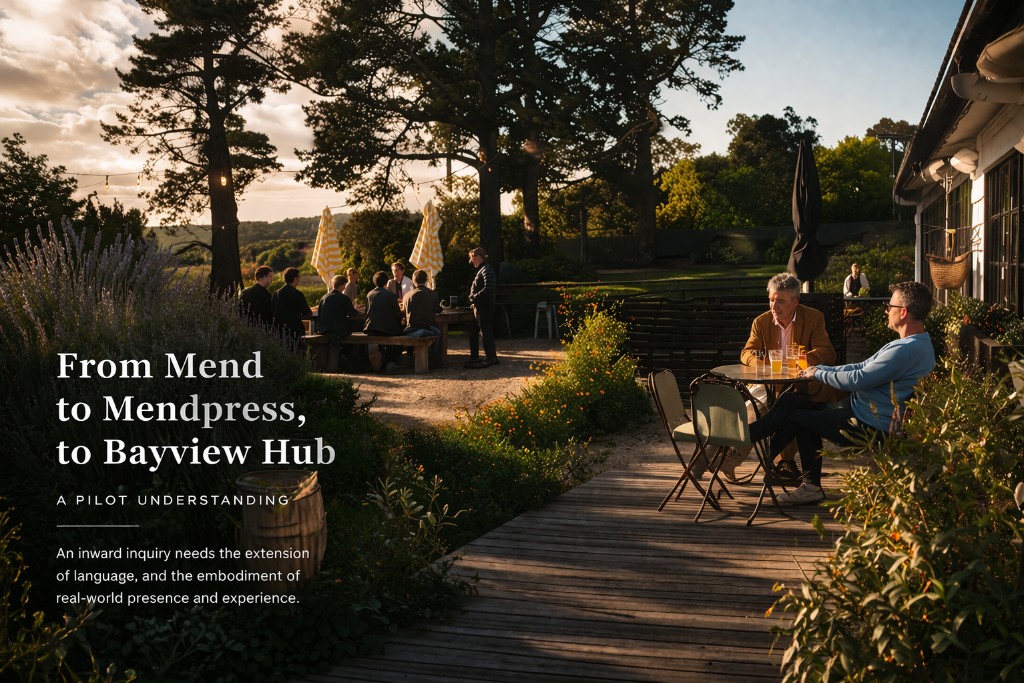
From Mend to Mendpress to Bayview Hub
Mend began as an inquiry into how inner life might become inhabitable again. Mendpress continues that inquiry in public through language, while Bayview Hub gives it embodied form through art, music, gardens, slowness, and shared human presence.
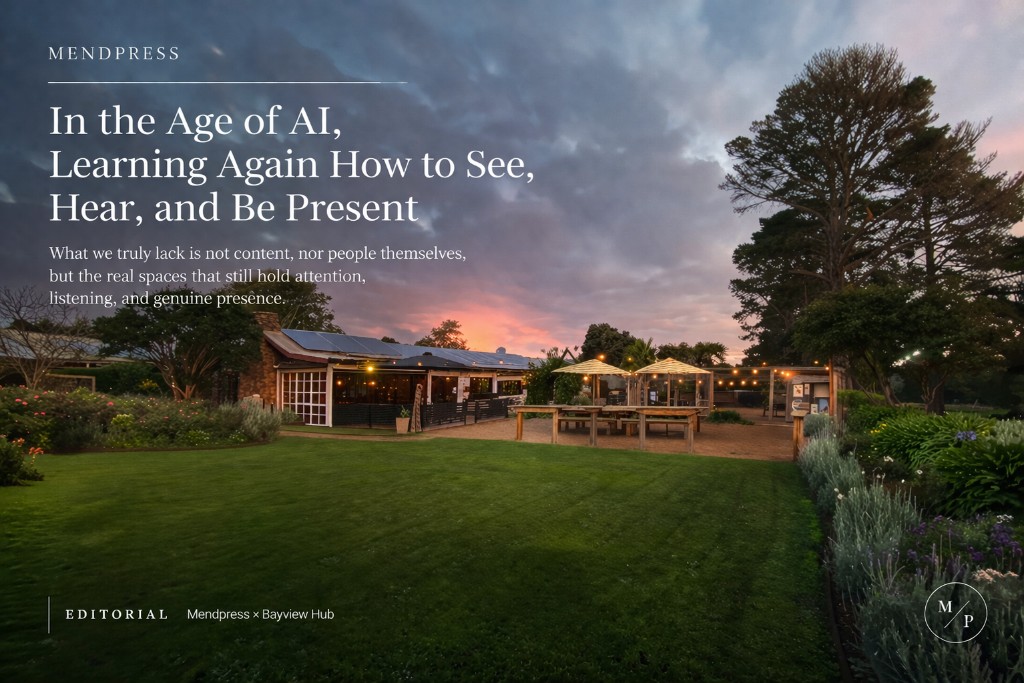
In the Age of AI, Learning Again How to See, Hear, and Be Present
In the age of AI, Mendpress begins from a simple conviction: what matters now is not more content, but the recovery of attention, presence, and truthful encounter through editorial thought, dialogue, images, and programme.
Share this piece
Keep the title, summary, and link close at hand for posting manually, without losing the platform tools.
Stay with Mendpress
Receive selected Mendpress pieces, invitations, and estate notes when there is something worth sharing.